
April is Sjögren's Awareness Month, but how many people have it and don't know?
An estimated 4 million Americans are living with Sjögren's disease, making it one of the most common autoimmune diseases in the country — and yet it remains one of the least recognized. Up to half of those affected may be undiagnosed, often because symptoms like dry eyes, dry mouth, and fatigue are dismissed or attributed to aging, allergies, or stress. Nine out of ten patients are women, and for many, the experience of being told their symptoms are not serious or not real is far too common.
The path to diagnosis has historically been long. As recently as 2012, patients waited an average of 6 years to receive a diagnosis, a number that has since reduced to around 3 years. One reason for the lengthy diagnosis period is that Sjögren's was traditionally thought to be a rare disease. New data from the Sjögren's Foundation, however, show that it may in fact be the second most common autoimmune disease. Yet, there is still no FDA-approved treatment for its systemic symptoms—a gap that represents one of the most urgent unmet needs in autoimmune care.
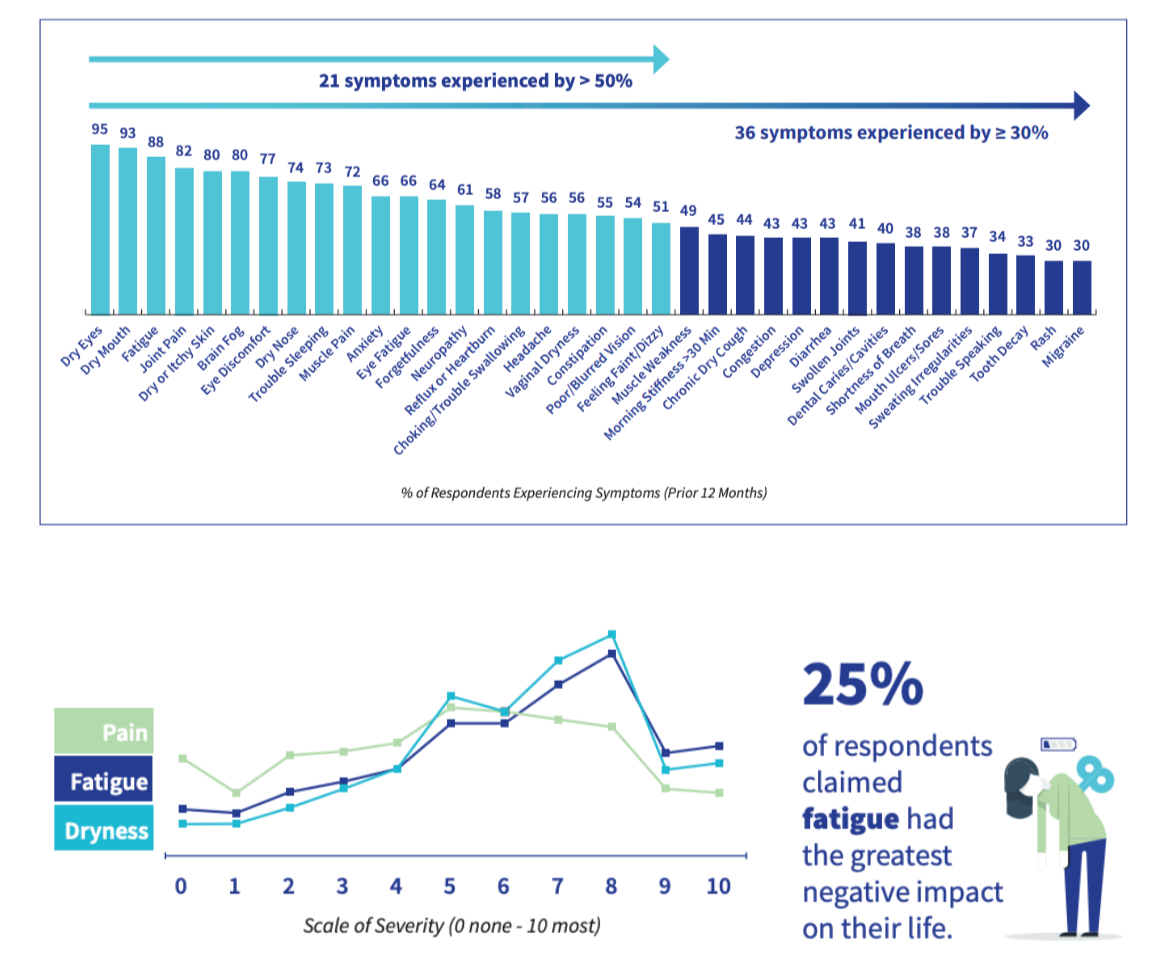
Despite outdated characterization of Sjögren's as a dry-eye, dry-mouth syndrome, it is in fact a systemic disease. Many patients also develop serious complications, including lung disease, kidney involvement, and peripheral neuropathy. According to the Living with Sjögren's Survey of 3,622 patients, while dry eyes and dry mouth affected 95% and 93% of respondents, 88% also reported fatigue, 82% reported joint pain, and 80% reported brain fog. Fatigue, dry eyes, dry mouth, and joint pain were most commonly reported to have major or moderate impacts on patients' quality of life: fatigue (79%); dry eyes (75%); dry mouth (73%); joint pain (65%), with 25% reporting fatigue to have the greatest negative impact on their lives. Moreover, 81% of patients reported the disease to cause a significant emotional burden.
Sjögren's also carries a meaningfully elevated cancer risk: a 2024 meta-analysis found that patients with Sjögren's face an 8.8-fold increased risk of non-Hodgkin's lymphoma compared to the general population, with 6.3 times higher risk for men and 9.6 times higher risk for women. Non-Hodgkin's lymphoma was also noted to affect women and younger adults more severely.
The gap between what patients are living with and what the healthcare system currently offers them has never been more visible or more urgent. Millions of patients are managing a complex, systemic disease with no FDA-approved treatment for its most debilitating symptoms. Awareness matters because it drives faster diagnosis, more research funding, and long-overdue focus on a disease that has been underfunded and underestimated for decades. The more patients who share their experiences and health histories, the stronger the case becomes for treatments that address the full scope of this disease.
If you have Sjögren's disease, your experience matters. Take our new Sjögren's Diagnostic and Treatment & Care surveys to add your voice to our registry.

Please join us tomorrow for our Monthly Webinar, where John Muller from Getting Up will be sharing his insights on the fundraising process and the operations of Getting Up.
Details: Thursday, April 16, 2026, from 12:00 to 1:00 PM EST
Agenda:
12:00 - 12:05 PM: Convene
12:05 - 12:10 PM: Introductions
12:10 - 12:40 PM: GettingUp.Org, A Volunteer-Powered Model for Rare Disease Impact
12:40 - 1:00 PM: Q&A
